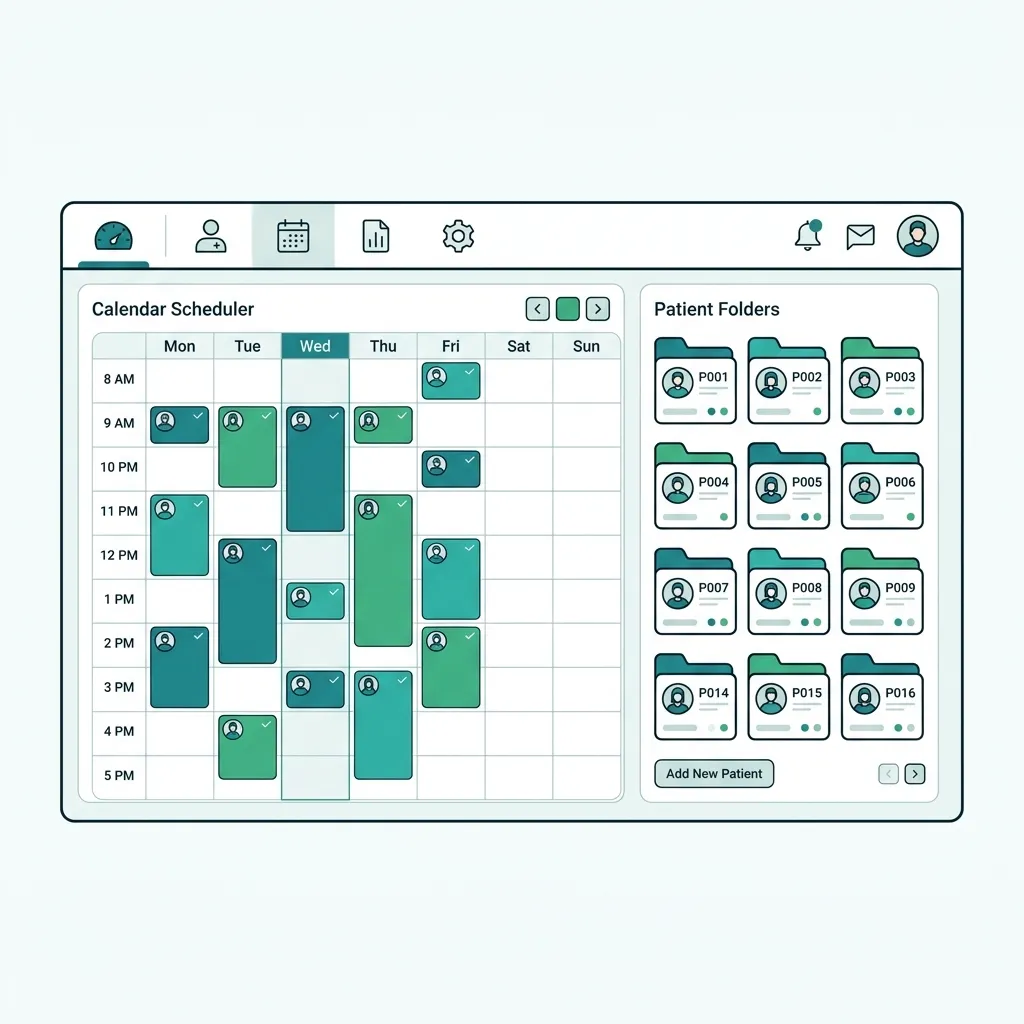
What is Hospital Management System (HMS)?
Hospital Management requires seamless connection across clinical, diagnostic, and financial units to deliver high-quality, patient-safe care. Tabeeb+ provides a 360-degree patient record, live ICU and bed occupancy tracking, surgical suite scheduling, and streamlined revenue cycle management (RCM).
Tabeeb+ Hospital Management System (HMS) is a cloud platform connecting inpatient beds, ER triage, surgical suites, pharmacy MAR, and labs with a unified medical record and ZATCA-compliant billing.
Challenges solved by Hospital Management System (HMS)
Hospital data fragmented across paper files and siloed software leads to medication errors, delayed ER triage reports, leaked revenue, and no clear visibility over beds or branch operations.
Core features of Hospital Management System (HMS)
Live Bed & ICU Occupancy Board
Real-time tracking of ward beds, ICU units, and NICU incubators with automated inter-department transfer logs.
ER Triage & Critical Care Pathway
Classify incoming emergency cases using standardized triage scores and track wait-time indicators.
Surgical Suite & OR Management
Schedule surgical operating rooms, balance surgical and anesthesia teams, and record post-op recovery notes.
Inpatient Pharmacy & MAR
Electronic medication administration records (MAR) with interaction alerts and automatic inventory deduction.
HL7 LIS & RIS Diagnostic Integration
Direct interface with lab auto-analyzers and radiology systems to sync reports into the patient's EMR.
Hospital RCM & ZATCA E-Invoicing
Phase 2 ZATCA e-invoicing compliance, insurance claim management, and rejection prevention workflows.
Clinical & operational benefits of Hospital Management System (HMS)
360-Degree Unified EMR
Complete view of patient history, inpatient stays, medications, and labs from one interface.
Enhanced Patient Safety
Drastically reduce medication errors and duplicate tests via live automated clinical alerts.
Financial & Operational Efficiency
Eliminate revenue leakage, automate insurance claims, and optimize bed rotation.
Who benefits from Hospital Management System (HMS)?
Hospital directors and medical executive office
Inpatient doctors and surgical specialists
Emergency & ICU critical care units
Inpatient pharmacy & lab/radiology teams
Medical quality & accreditation teams (CBAHI & JCI)
Hospital revenue cycle management (RCM) teams
1. Concept & Historical Evolution of Hospital Management
Hospital Management is an advanced clinical and administrative discipline covering strategic planning, executive organization, and operational control over healthcare delivery.
- Paper-Based Era: Manual registers leading to high medication error rates and delayed billing.
- On-Premise HMS Era: Local servers with heavy maintenance overhead and frequent downtime.
- Cloud & AI HMS Era (2026): Tabeeb+ platform orchestrating beds, ER, OR, pharmacy, and EMR with live ZATCA e-invoicing.
2. The Five Core Pillars of Modern Hospital Governance
Modern hospital operations rely on 5 interconnected pillars ensuring patient safety and financial sustainability:
Clinical & Diagnostic Operations
Outpatient clinics, inpatient wards, ER, OR, LIS lab, and RIS radiology.
Revenue Cycle Management (RCM)
Phase 2 ZATCA e-invoicing, insurance claim automation, and rejection management.
Supply Chain & Pharmacy
Central medical store, inpatient pharmacy MAR, and expiry alerts.
Healthcare HR & Nursing
Shift rosters and nurse-to-patient ratio optimization.
Quality & Compliance
CBAHI, JCI, HIPAA, and PDPL compliance.
How to get started with Hospital Management System (HMS)
Department & Org Structuring
Map wards, beds, clinical staff, and granular role permissions.
Encrypted Data Migration
Safely transfer EMR, pharmacy inventory, and master patient data.
Connect ER, Pharmacy & Inpatient
Enable critical care modules, live bed tracking, and MAR alerts.
Staff Training & Seamless Go-Live
Train doctors, nurses, and billing teams for uninterrupted go-live.
Hospital Management System (HMS) comparison & evaluation
Tabeeb+ Cloud HMS versus legacy hospital systems.
| Operational Criterion | Tabeeb+ Cloud HMS | Legacy On-Premise Systems |
|---|---|---|
| Unified EMR | 360-degree cross-department record | Fragmented, duplicated files |
| Bed Management | Live bed and ICU occupancy board | Manual registers and spreadsheets |
| Billing & Insurance | 100% ZATCA Phase 2 & RCM compliant | Manual updates causing claim denials |
| Deployment & Security | AES-256 encrypted cloud with mobile access | High maintenance local servers |
| Multi-Branch Support | Centralized cloud for multi-hospital networks | Disconnected local installations |
Best practices for implementing Hospital Management System (HMS)
- Establish role-based access for inpatient, ER, and finance teams
- Connect pharmacy MAR and diagnostics directly to the EMR
- Train ER admission staff on electronic triage workflows
- Review bed occupancy KPIs and claim approval rates weekly
Common pitfalls when choosing Hospital Management System (HMS)
Keeping inpatient data siloed outside the main EMR
Failing to standardize bed numbering across hospital branches
Neglecting daily encrypted cloud backups and security audits
Key takeaways for Hospital Management System (HMS)
Key Takeaways
- A unified HMS boosts bed turnover and stops revenue leakage
- ER triage and inpatient care require real-time tracking and clinical alerts
- Compliance with ZATCA and CBAHI guarantees smooth hospital governance
Final summary on Hospital Management System (HMS)
Tabeeb+ Cloud Hospital Management System is the foundation for patient safety and peak clinical, financial, and operational efficiency across all hospital departments.
Frequently Asked Questions
What is the difference between EMR and HMS?
EMR focuses on clinical record documentation, while HMS encompasses EMR plus inpatient beds, ER triage, surgical suites, pharmacy MAR, RCM, and hospital supply chain.
Is Tabeeb+ ZATCA E-Invoicing Phase 2 compliant?
Yes, Tabeeb+ fully supports ZATCA Phase 1 & Phase 2 e-invoicing and hospital insurance billing integration.
How are inpatient and ICU beds managed?
Via a live dashboard tracking bed availability, inter-department transfers, and automated daily stay billing.
Does it connect with lab auto-analyzers (HL7)?
Yes, it supports standard HL7 interfaces to import lab and radiology diagnostic results straight into the patient's EMR.
Can multi-branch hospital networks be managed centrally?
Absolutely. Tabeeb+'s multi-tenant cloud architecture provides central executive dashboards for all hospital locations.
What security standards protect hospital data?
All data is secured using AES-256 encryption, conforming to PDPL guidelines and international HIPAA privacy rules.
What clinic owners say
Real feedback from clinic managers and medical centers running on Tabeeb+ every day.
“Tabeeb+ helped us connect 120 inpatient beds and ER triage to a unified EMR, reducing triage wait times by 40%.”
“ZATCA-compliant billing and RCM workflows cut our insurance claim denial rates dramatically.”
“Inpatient pharmacy MAR and OR scheduling are now effortlessly managed from web and mobile.”
Read also
Try Tabeeb+ Free
Start your free trial and turn your clinic into a smart digital system.
Launch Your Cloud Clinic Free