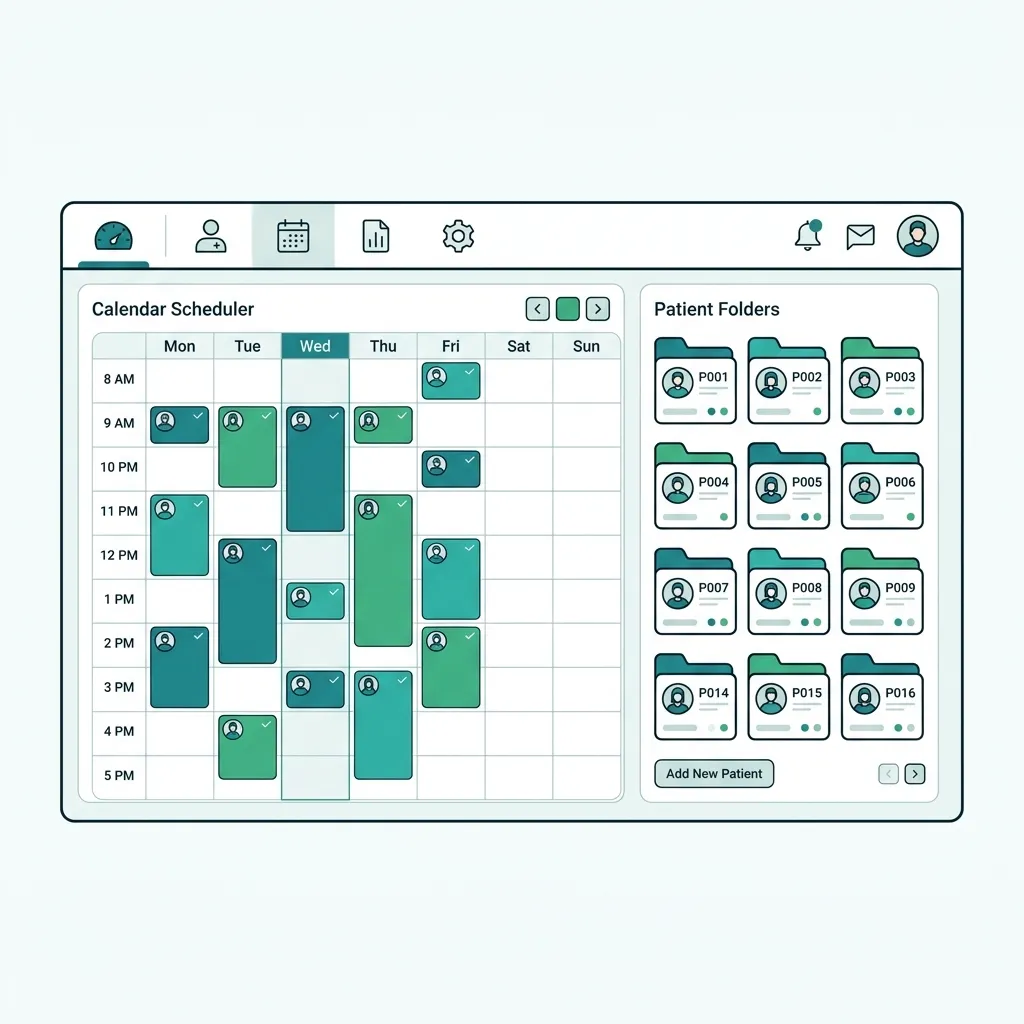
What is Electronic Health Record (EHR) Software?
An Electronic Health Record (EHR) is a comprehensive digital system that goes beyond storing a patient's chart within a single clinic — it connects all parties involved in a patient's care, including hospitals, laboratories, pharmacies, and government regulatory bodies, into a unified, secure data network. Unlike EMR software that operates within a single institution, EHR enables cross-institutional data exchange through international standards such as FHIR, HL7, and Health Information Exchange (HIE) protocols. This allows the treating physician to access the patient's complete history from any source, reducing duplicate diagnoses, unnecessary testing, and improving care coordination across specialists. The EHR system is an essential tool for complying with increasingly stringent government healthcare regulations and patient data protection laws, and is widely adopted in large public health systems requiring unified tracking and full data transparency across care settings.
An Electronic Health Record (EHR) is a digital system that connects patient records across multiple hospitals, clinics, and labs, enabling secure, interoperable data sharing and care coordination using standards like FHIR and HL7.
Challenges solved by Electronic Health Record (EHR) Software
Healthcare institutions face data silos: every hospital, clinic, and laboratory maintains separate records, leading to duplicate diagnoses, unnecessary testing, and critical delays in emergencies. Without an EHR, physicians must request printed reports or rely on patient recall, exposing patients to serious medical errors. Furthermore, government mandates for digital health data exchange are expanding rapidly, and institutions lacking EHR systems face regulatory penalties, reduced reimbursement, and potential loss of operating licenses.
Core features of Electronic Health Record (EHR) Software
Health Information Exchange (HIE)
Securely share patient records between hospitals, clinics, and laboratories using internationally certified HIE protocols.
Interoperability & Integration
Support for FHIR and HL7 standards to connect diverse healthcare systems and make data exchangeable and analyzable.
Cross-Provider Care Coordination
Comprehensive tracking of the patient journey across specialist physicians and hospitals with unified treatment plans.
Unified Cross-Facility Patient Record
A single health record per patient encompassing full medical history from all institutions involved in their care.
Advanced Patient Portal Access
Patient self-service portal displaying their complete health record across all facilities with appointment management.
Healthcare Analytics & Regulatory Reporting
Interactive dashboards measuring care quality, government compliance, and operational efficiency across institutions.
Clinical & operational benefits of Electronic Health Record (EHR) Software
Eliminate Duplicate Diagnostics
Full access to cross-facility patient records prevents unnecessary repeated lab tests and imaging.
Improve Cross-Facility Care Quality
Coordinated care between physicians and hospitals reduces medical errors and enhances treatment outcomes.
Meet Government Healthcare Mandates
Comply with government health data exchange regulations and avoid penalties and license revocations.
Reduce Institutional Costs
Lower operational costs through unified infrastructure and elimination of manual record copying and transfer.
Who benefits from Electronic Health Record (EHR) Software?
Multi-facility hospital networks and medical centers requiring unified patient record sharing across branches
Public health systems and government health ministries mandating standardized health data exchange
Academic medical centers linking clinical training with unified, longitudinal patient records
Large physician practice groups (ACOs/IPAs) coordinating care across multiple providers and institutions
Long-term care and home health agencies requiring seamless record continuity between hospital and home
How to get started with Electronic Health Record (EHR) Software
Assess Requirements & Technical Standards
Identify required partner institutions, government compliance requirements, and necessary technical standards (FHIR/HL7).
Select Vendor & Integration Architecture
Choose an EHR vendor supporting FHIR/HL7 standards with open API interfaces for connecting existing systems.
Pilot Data Exchange & Validation
Run real data exchange tests with partner institutions to validate information accuracy and privacy protection.
Full Deployment & Continuous Training
Go live with the system and train clinical and technical staff on data exchange interfaces and regulatory compliance.
Electronic Health Record (EHR) Software comparison & evaluation
Comparison: Paper Records vs. EMR vs. EHR vs. Clinic OS
| Feature | Paper Charts | EMR Software | EHR System | Clinic OS (Tabeeb+) |
|---|---|---|---|---|
| Cross-Institution Sharing | Nearly impossible | Very limited (manual export) | Broad via HIE/FHIR standards | Broad with unified integration |
| FHIR/HL7 Compliance | N/A | Rarely supported | Internationally certified & required | Fully supported with open API |
| Cross-Specialist Care Coordination | Patient-dependent | Within single clinic only | Across multiple institutions | Cross-facility with centralized mgmt |
| Government Exchange Compliance | Non-compliant | Very limited | Purpose-built for this | Compliant with local regulations |
| Cost & Infrastructure | Lowest cost | Affordable (SaaS) | High (enterprise projects) | Scalable mid-range cost |
| Comprehensive Patient Record | Not possible | Single clinic record only | Cross-facility health record | Full record + clinic automation |
Best practices for implementing Electronic Health Record (EHR) Software
- Define required technical standards (FHIR/HL7) before vendor selection to ensure compatibility with your EHR infrastructure.
- Run a simulated data exchange pilot with partner institutions before full deployment to validate integration integrity.
- Train your internal IT team on access permissions and security management to protect patient privacy across networks.
- Review government compliance reports monthly to ensure the system meets all evolving regulatory requirements.
Common pitfalls when choosing Electronic Health Record (EHR) Software
Selecting a basic EMR that lacks FHIR/HL7 standards and attempting integration later, resulting in costly system rebuilds.
Neglecting to train physicians and clinical staff on data exchange interfaces, leading to fallback on manual data entry.
Ignoring cross-jurisdictional privacy requirements when sharing patient records across institutions in different regions.
Key takeaways for Electronic Health Record (EHR) Software
Key Takeaways
- EHR software connects patient records across multiple institutions using FHIR, HL7 standards, and Health Information Exchange protocols.
- EHR systems reduce duplicate diagnostics and improve care quality by coordinating information across all healthcare providers.
- Integrated cloud platforms like Tabeeb+ balance enterprise-grade EHR capabilities with affordable, scalable costs for clinics and medical centers.
Final summary on Electronic Health Record (EHR) Software
Electronic Health Record (EHR) software is the optimal solution for healthcare institutions seeking to share medical records and coordinate care across multiple facilities. By supporting FHIR, HL7 standards, and HIE protocols, the system ensures seamless data exchange with complete patient privacy protection. Start today with an integrated EHR that meets government compliance mandates and improves healthcare quality for your patients.
Frequently Asked Questions
What is the difference between EMR and EHR?
An EMR is the clinical chart for a single clinic only, whereas an EHR is a comprehensive health record supporting data sharing across multiple institutions using FHIR, HL7, and HIE standards.
Is EHR software mandatory by law in Saudi Arabia and the Arab world?
Government mandates for digital health data exchange are expanding across many Arab countries. EHR systems ensure full compliance with healthcare data regulations and patient privacy protection.
How much does implementing EHR software cost for a healthcare institution?
Costs vary by institution size and number of facilities. Integrated cloud platforms like Tabeeb+ offer EHR capabilities at affordable monthly subscription rates compared to large-scale enterprise implementations.
Read also
Try Tabeeb+ Free
Start your free trial and turn your clinic into a smart digital system.
Launch Your Cloud Clinic Free