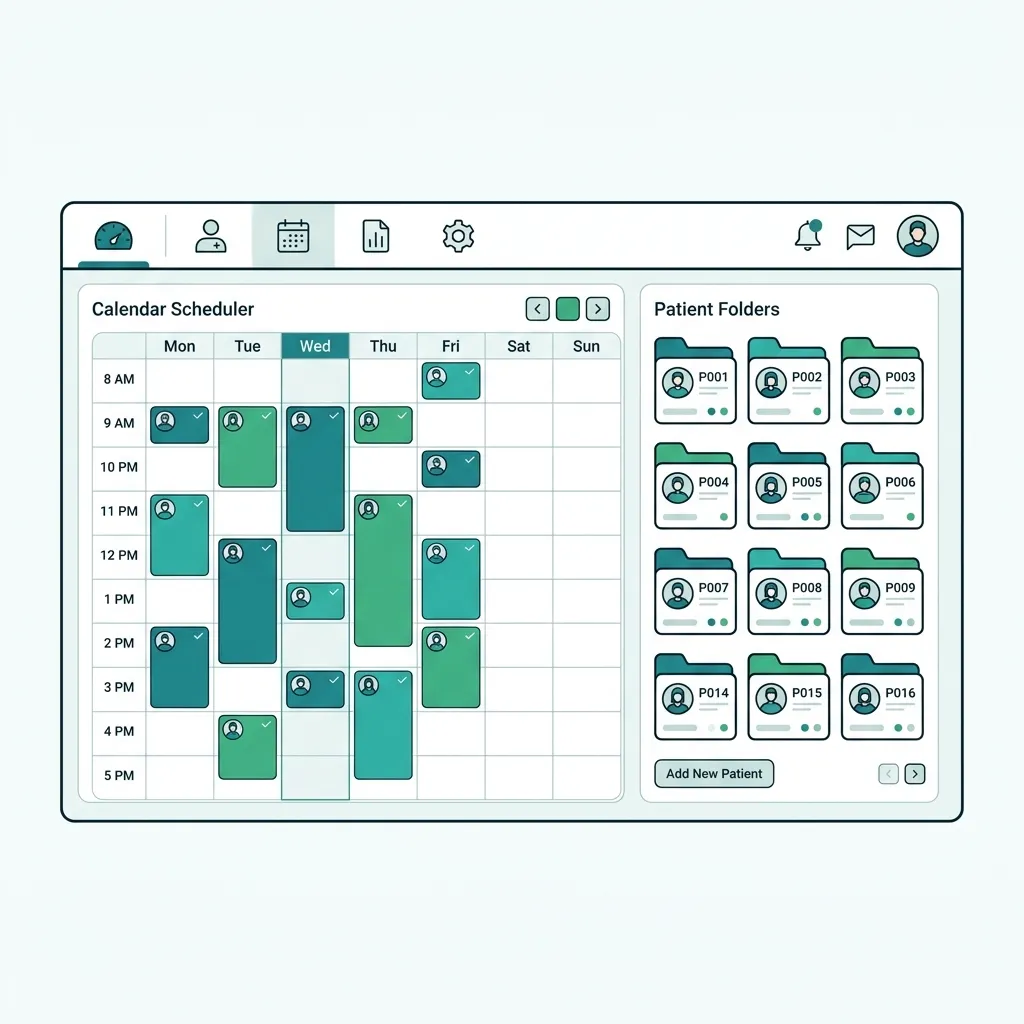
What is Healthcare Automation | Medical Practice Automation?
Healthcare automation is the process of transforming manual, repetitive workflows in medical facilities into automated digital operations powered by software and artificial intelligence. It spans a wide spectrum — from patient registration and appointment scheduling to complex billing, analytics, and automated patient communication via WhatsApp or SMS. Unlike limited clinic automation, healthcare automation addresses the complexities of multi-branch, multi-department institutions such as hospitals, laboratories, pharmacies, and imaging centers, providing a unified digital backbone that connects all these entities into a single integrated platform.
Healthcare automation is the use of technology to automate clinical, administrative, and financial workflows across all healthcare settings — from solo clinics to hospital networks — including automated billing, patient communication, AI-assisted diagnosis, and analytics dashboards.
Challenges solved by Healthcare Automation | Medical Practice Automation
Healthcare facilities face enormous challenges amid growing staff shortages, clinician burnout, and costly manual errors. Studies show that physicians spend twice as much time on administrative tasks as on direct patient care. Manual billing processes cause significant revenue leakage, and non-automated patient communication drives up no-show rates. Additionally, increasing regulatory pressures and data protection requirements make manual workflows impractical and risky for both patient safety and institutional reputation.
Core features of Healthcare Automation | Medical Practice Automation
Clinical Workflow Automation
Automate patient registration, data transfer between departments, and clinical handoffs while preserving record integrity.
AI-Assisted Diagnosis
Analyze clinical data and generate early alerts for critical conditions using machine learning algorithms.
Comprehensive Automated Billing
Generate invoices automatically from clinical records with support for multiple insurance providers and payers.
Automated Patient Communication
Send appointment reminders, follow-ups, and lab results via WhatsApp, SMS, and email automatically.
Inventory & Pharmacy Management
Automated tracking of medications and medical supplies with automatic reorder alerts and expiry tracking.
Analytics & Reporting Dashboards
Interactive dashboards displaying key performance indicators for data-driven decision making.
Clinical & operational benefits of Healthcare Automation | Medical Practice Automation
Reduce Medical & Administrative Errors
Automation eliminates manual errors in billing, prescriptions, and data entry.
Increase Revenue by Eliminating Financial Leakage
Automated tracking of all financial transactions ensures every billable item is captured.
Improve Patient Experience & Loyalty
Instant automated communication reduces wait times and significantly boosts patient satisfaction.
Full Regulatory & Standards Compliance
Automated documentation and digital audit trails satisfy regulatory review requirements effortlessly.
Who benefits from Healthcare Automation | Medical Practice Automation?
Hospitals and large medical centers seeking to automate workflows across multiple departments
Multi-branch clinic groups needing centralized visibility and unified management
Medical laboratories requiring automated test ordering, result delivery, and inventory management
Pharmacies and pharmaceutical centers requiring automated inventory and billing
Government and private healthcare systems requiring strict regulatory compliance
Healthcare providers aiming to reduce billing errors and revenue leakage
How to get started with Healthcare Automation | Medical Practice Automation
Assess Current Workflows
Identify the most time- and cost-consuming manual processes in your current facility.
Set Priorities & Goals
Start with billing and scheduling automation and define measurable KPIs.
Select the Right Platform
Choose a system that integrates with existing tools and offers scalable expansion.
Train & Phase Rollout
Train staff and launch automation in small departments before full-scale rollout.
Monitor & Continuously Improve
Track performance metrics and refine workflows based on real operational data.
Healthcare Automation | Medical Practice Automation comparison & evaluation
Comparison: Manual Processes vs. Basic Digital Tools vs. Full Healthcare Automation
| Feature | Manual Processes | Basic Digital Tools | Full Healthcare Automation (Tabeeb+) |
|---|---|---|---|
| Billing & Collections Speed | Slow and error-prone (days) | Moderate (hours) | Instant (minutes) |
| Inventory & Medication Tracking | None or manual count-down | Unsynchronized Excel sheet | Automated tracking with reorder alerts |
| Revenue Leakage Reduction | Frequent errors (up to 15% leakage) | Fewer errors but still present | Near-zero billing errors |
| Automated Patient Communication | Manual phone calls | Email only | WhatsApp + SMS + Email |
| Analytics & Decision Support | Monthly manual reports | Basic dashboards | Live interactive dashboards with AI predictions |
Best practices for implementing Healthcare Automation | Medical Practice Automation
- Start by automating the simplest workflows (appointments, billing) before advancing to clinical automation.
- Choose an automation platform that integrates with your existing systems to avoid unnecessary complexity.
- Assign an internal team responsible for monitoring KPIs post-automation and continuously improving workflows.
- Involve clinicians in the automation design process to ensure the system matches real clinical needs.
Common pitfalls when choosing Healthcare Automation | Medical Practice Automation
Attempting to automate everything at once instead of adopting a phased, prioritized approach.
Ignoring staff training, which leads to low adoption rates and wasted investment in automation tools.
Choosing a closed system that does not integrate with existing EMR, billing, or insurance platforms.
Key takeaways for Healthcare Automation | Medical Practice Automation
Key Takeaways
- Healthcare automation covers all clinical, administrative, and financial workflows across single facilities or multi-branch networks.
- Starting with billing and scheduling automation delivers the fastest ROI before expanding to clinical automation.
- Integration with existing systems (EMR, insurance platforms, labs) is the key to any successful healthcare automation project.
Final summary on Healthcare Automation | Medical Practice Automation
Healthcare automation is no longer a luxury — it is a necessity in modern medical practice. With Tabeeb+ comprehensive platform, any healthcare facility — whether a solo practice or a multi-department hospital — can automate workflows efficiently, reduce errors and leakage, and dramatically improve patient experience. Start your healthcare automation journey with Tabeeb+ today with a free trial.
Frequently Asked Questions
What is healthcare automation?
Healthcare automation is the use of software and artificial intelligence to automate clinical, administrative, and financial workflows across all healthcare settings, from small clinics to large hospitals.
How does automation reduce medical errors?
Automated billing and prescription management eliminates repetitive manual data entry, reducing billing errors significantly and preventing dangerous drug interactions and incorrect charges.
Is healthcare automation expensive?
On the contrary, healthcare automation delivers a clear financial return by eliminating revenue leakage and reducing administrative hours. Platforms like Tabeeb+ offer flexible plans suitable for facilities of all sizes.
Read also
Try Tabeeb+ Free
Start your free trial and turn your clinic into a smart digital system.
Launch Your Cloud Clinic Free